20:00
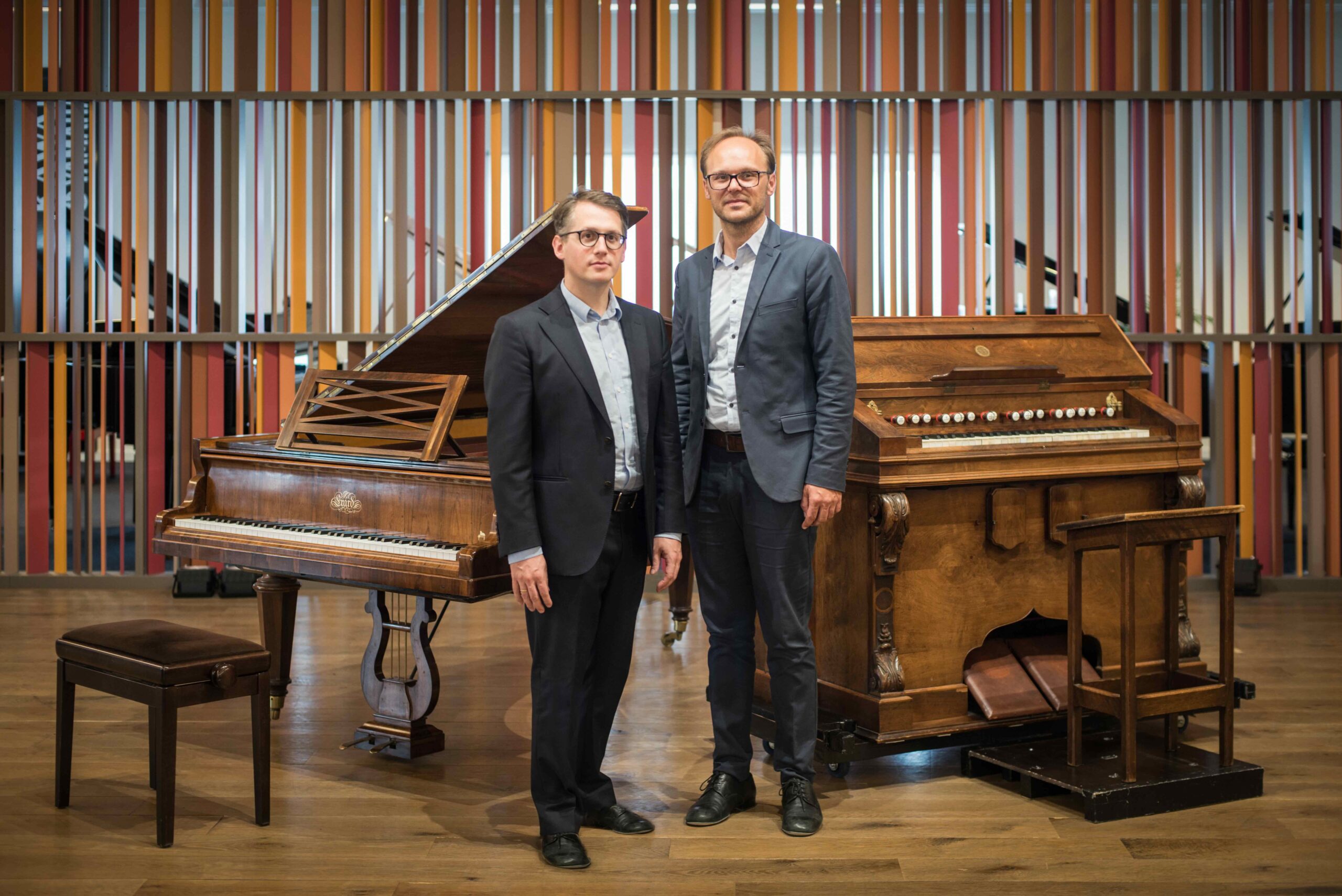
Al meer dan twintig jaar zijn toetsenisten Nicolas Callot en Bart Rodyns vrienden en delen ze een liefde voor historische toetsinstrumenten. Als Duo Zeitspiel kiezen ze in hun nieuwste project rond de muziek van Felix Mendelssohn opnieuw voor de ongewone combinatie van piano en harmonium, na een Bach-album met hetzelfde instrumentarium. De link tussen Bach en Mendelssohn is sterk: het was Mendelssohn die het werk van Bach weer onder de aandacht bracht, na een periode van vergetelheid.
Wat voor Bach werkt, blijkt ook voor Mendelssohn te werken. Het symbiotische samenspel van Callot en Rodyns benadrukt hoe goed de piano en het harmonium elkaar aanvullen. De bassen van het harmonium geven de piano een ongekende diepte, terwijl de melodie moeiteloos en tegelijk subtiel boven het geheel weet uit te stijgen.
For more than twenty years, keyboardists Nicolas Callot and Bart Rodyns have been friends and have shared a love of historical keyboard instruments. As Duo Zeitspiel, in their latest project centred on the music of Felix Mendelssohn, they have once again opted for the unusual combination of piano and harmonium, following on from a Bach album featuring the same instruments. The link between Bach and Mendelssohn is strong: it was Mendelssohn who brought Bach’s work back into the spotlight after a period of obscurity.
What works for Bach also proves to work for Mendelssohn. The symbiotic interplay between Callot and Rodyns emphasises just how well the piano and the harmonium complement each other. The harmonium’s bass notes lend the piano an unprecedented depth, whilst the melody rises effortlessly yet subtly above the whole.
Nicolas Callot piano
Bart Rodyns harmonium
J. S. Bach / G. Kurtág
–
Gottes Zeit ist die allerbeste Zeit (naar Actus Tragicus, BWV 106)
J. S. Bach
–
Nun komm, der Heiden Heiland, BWV 659
F. M. Mendelssohn Bartholdy / C. G. Lickl
–
Lied ohne Worte op. 30 nr. 6 Venetianisches Gondellied
J. S. Bach
–
Aus Liebe will mein Heiland sterben uit de Matthäus-Passion, BWV 244
F. M. Mendelssohn Bartholdy / C. G. Lickl
–
Felix Mendelssohn Bartholdy / Carl Georg Lickl Lied ohne Worte op. 19 nr. 4 Moderato
A. Marcello / J. S. Bach
–
Adagio uit het Hoboconcerto in d klein, BWV 974
F. M. Mendelssohn Bartholdy / C. G. Lickl
–
Lied ohne Worte op. 19 nr. 3 Molto allegro e vivace
J. S. Bach / F. M. Mendelssohn Bartholdy
–
Chaconne uit Partita nr. 2 in d klein voor viool solo, BWV 1004